Social Work MSW Macro Spotlight: Melissa Wilson
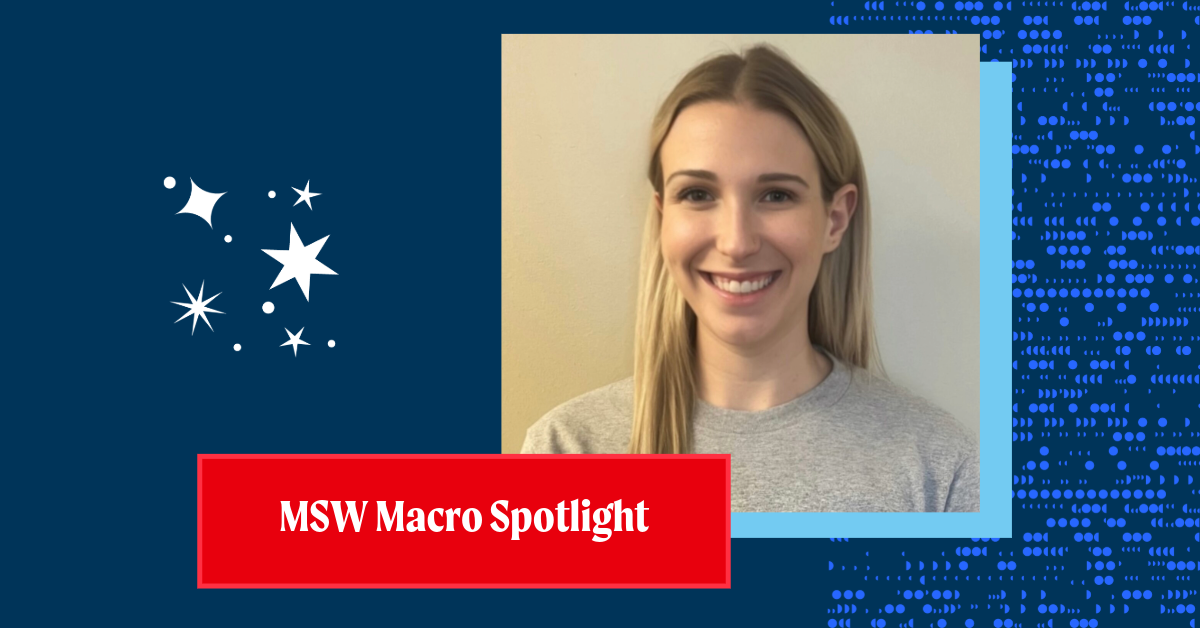
Melissa Wilson wants to help those without easy access to resources, and that means making tangible change to the system.
Wilson, MSW 2023, graduated from the University of Kansas School of Social Welfare with a macro specialization to do just that. Wilson always wanted to help people through her career. Her job at the Missouri State Public Defender's office as a mitigation specialist helps her do that.
Why did you choose a macro specialization?
My first year I was micro, and then I did my first year of practicum at a homeless shelter and doing that day-to-day crisis work was my first experience working with a different population.
I think I just noticed that so many things are wrong from the top that are making the bottom impossible to progress or get into better spaces. No matter how hard we work to get people connected with resources, at the end of the day there has to be change up top first.
What does a typical day look like for you?
Not every day looks the same, but generally, what I do as a mitigation specialist is I work really closely with clients who are in custody at Jackson County Detention Center here downtown.
Once the attorneys are assigned a new case and they do their initial meeting with the client…that's when I step in. I go meet with the client and do an intake with them.
A majority of our clients are homeless. And if you're homeless, the judges and the courts aren't going to let you out on bond simply because you don't have anywhere to go. It makes it harder for them to keep track of you.
What we do is we work with clients, evaluate their needs, and we use that to reach out to different community partners—primarily sober living, transitional living programs, mental health treatment—and we work with the clients and community partners to coordinate what we call a home plan. The attorneys will take that home plan to the judge, and usually we are able to get our clients out on bond.
The second part of my responsibilities is when clients are preparing for trial. To help prepare for that sentencing is what we call mitigation, and what that looks like is going and sitting down with the client. We go through their childhood, their environment, and things that they were exposed to, and we try and understand some of the circumstances that have led them to being in the criminal justice system. When sentencing does come around, it's an opportunity for them to have that report and for us to present the client beyond their charges to the judge and humanize them.
Do you think your current position has shaped your worldview?
In my first practicum, I was at a homeless shelter. My second year of practicum, I actually started [at the Missouri State Public Defender's office] as an intern and have been here ever since my practicum. I acknowledge that I grew up in Overland Park, I grew up with privilege, and just kind of learning that using that privilege for people who their voices aren't heard.
I don't think [my worldview] necessarily changed because I've always felt this way, but it really allows you to humanize people and humanize situations that on paper or on the news might sound terrible… everybody has their own story and circumstances, and people shouldn't be defined by their circumstances. It's definitely one of the biggest things I've learned over the past few years.
What advice would you give to current MSW students?
Explore all of the different opportunities and different levels of social work. Over two years, a lot of my interests and perceptions changed. For the first time in my life, I felt like I know what I want to do, when in the past I was just going through the motions, trying to graduate, and trying to find a job.
I would say explore every area. Give people the opportunity to teach you new things, learn about new populations, and really just engage in your community and start building relationships. You never know when you might need somebody you know.