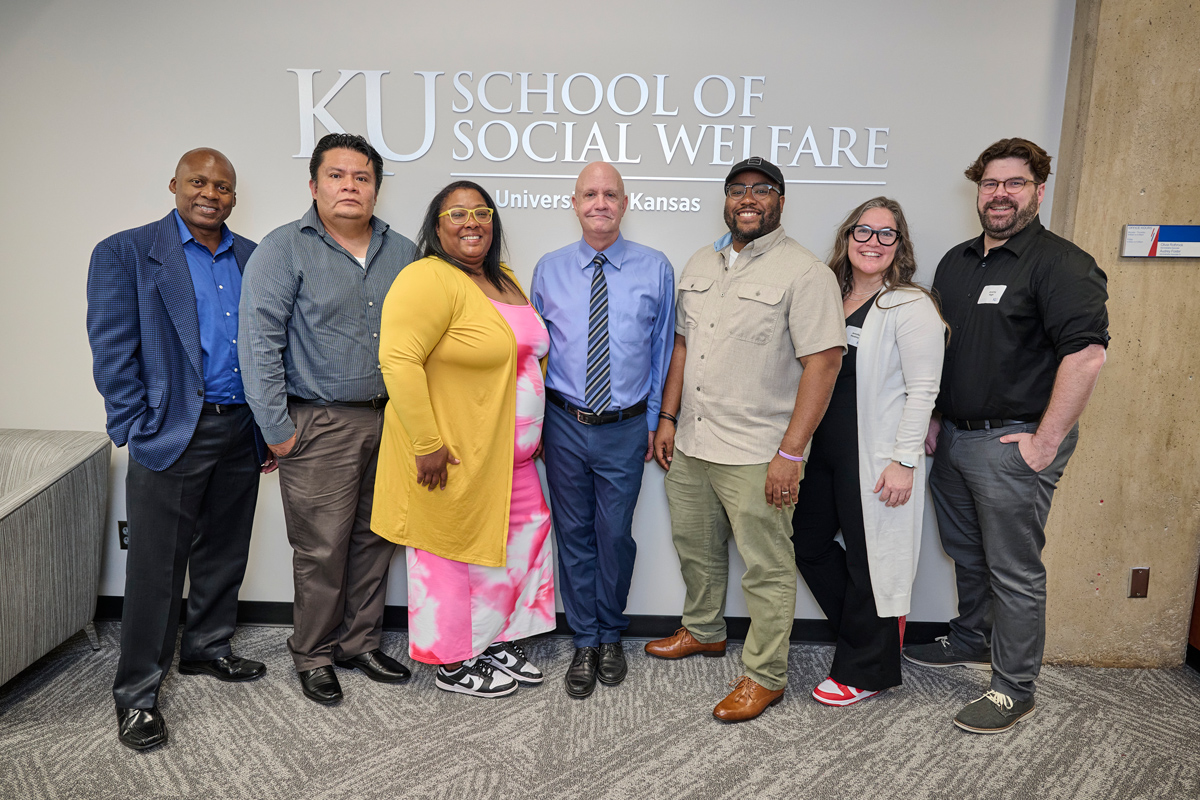
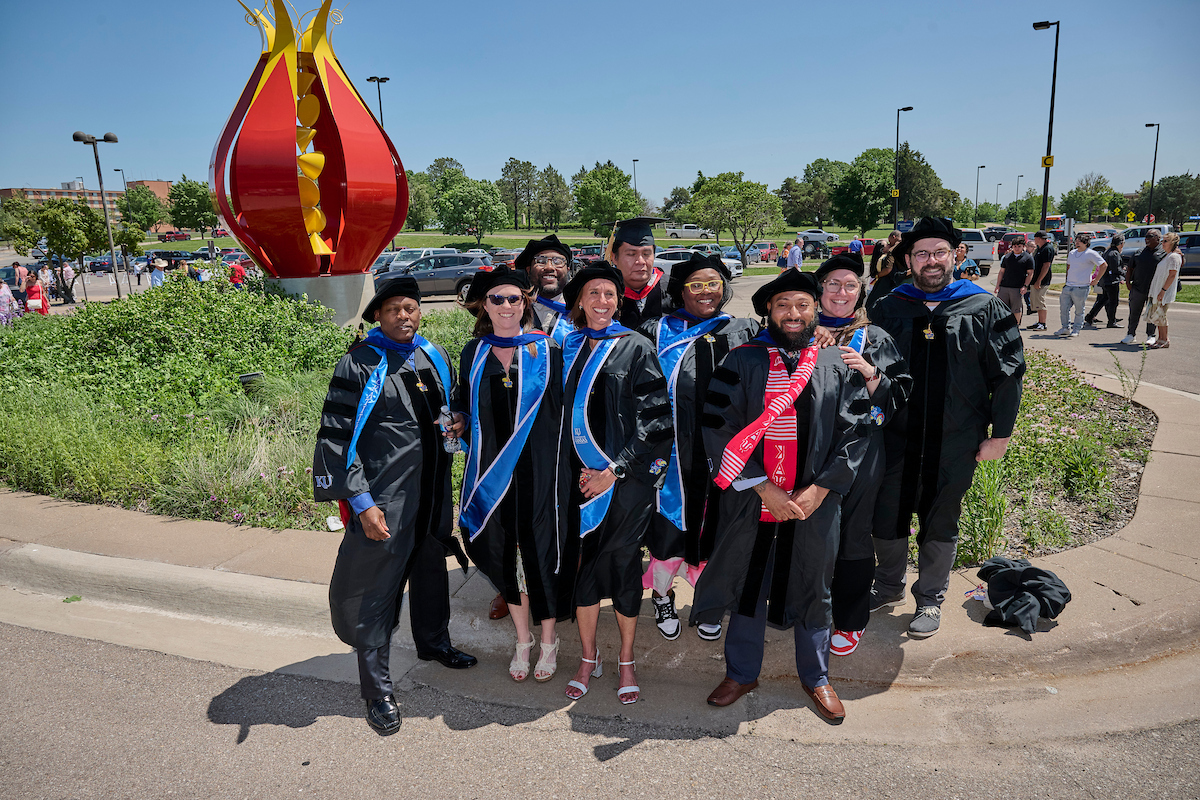
KU DSW graduates complete capstone projects

This year, eight students from the fully online Doctor of Social Work (DSW) program completed their capstone defense projects and earned their DSW degree. The program at the University of Kansas aims to train expert practitioner-scholars, focusing on leadership, management, teaching, and implementation science.
"I believe that our capstone projects in the DSW Program are really exciting. Our goal in the DSW Program is to help our students grow into Scholarly Practitioners, or people with strong capabilities to approach practice through well-developed intellectual frameworks, and who can also engage intellectual frameworks with the knowledge of practice realities," said DSW program director Ed Scanlon. "The capstones help build these abilities as the students produce scholarship that solves real world problems in novel ways.
"The projects have the potential to be living, usable intellectual products that link the social work academy with daily social work practice and the lives of the people we are trying to serve."
DSW students have at least three years of social work practice experience beyond their Master of Social Work degree.
The students’ capstone projects spanned a variety of social work topics, including youth health, social work practicum education, mental health services and healthcare access. The coursework and capstone projects enabled students’ expansion of their social work careers.
“My DSW training in leadership and implementation science has prepared me for the next chapter in my career in program development and implementation, as well as enhanced my implementation of clinical interventions with clients,” said DSW graduate Jerald Payne.
Here are the DSW students from the program’s first cohort who have completed their capstone defenses:
Rebecca Beeler, DSW
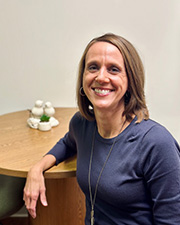
Project title: “Building a Community Coalition to Increase the Health Insurance Literacy of Medicare Beneficiaries”
Rebecca Beeler’s capstone project builds on her work as a medical social worker and director of a discharge planning department. Beeler identified a problem of practice in her community: the difficulties citizens have in understanding Medicare options and the challenges they face when choosing the most appropriate plan for their needs, which often can result in barriers to obtaining needed medical care. In response to this identified problem, Beeler created a capstone artifact that is a step-by-step guide to using Community Coalition Action Theory to build Medicare Literacy Coalitions to educate community members.
Jeremy High, DSW
Project title: “Advancing Smart Decarceration: Addressing Problems of Responsivity in Social Work Intervention Targeting Recidivism Among Those Who Experience Mental Illness and Substance Use Disorders”
Jeremy High’s capstone project seeks to develop reentry programming that supports individuals who experience mental illness, substance use disorders, or both, and are returning to the community from city and county jails, which reduces these individuals' risks of returning to jail. High created a guide for those who provide jail reentry services. The guide innovatively applies Therapeutic Jurisprudence to current risk-based approaches within service provision to adults leaving jail.
Jennifer Hoskins, DSW

Project title: “Educating and Training Social Workers to Expand Access to Mental Health Services with the Intellectual Disability Community”
Jennifer Hoskins focused on solving a problem of practice: the lack of knowledge and a need among practitioners for increased self-determination to improve access to quality care for mental health service delivery with the intellectual disability (ID) population. In response to this issue, this capstone project developed a training program for social workers that combines foundational knowledge of the ID experience with the Self-Determined Learning Model of Instruction (SDLMI) – an evidence-based intervention originally designed for special education. This innovative approach repurposes SDLMI to strengthen self-determination among social workers. The training guide incorporates the Active Implementation Frameworks to support long-term use and sustainability.
Jerald Payne, DSW

Project title: “Cost-Sharing in the Form of High-Deductible Health Plans and Copays: Creating a Nonprofit Private Practice Business Model for Eliminating Financial Barriers to Mental Healthcare”
Jerald Payne’s capstone project created a “how-to” manual and business plan template for establishing nonprofit private practices to deliver mental healthcare to clients with high-deductible health plans who cannot afford their insurance cost-sharing fees. Cost-sharing mechanisms – such as coinsurance, high deductibles, copays and out-of-pocket maximums – act as significant barriers to accessing mental healthcare in the United States. Payne’s capstone seeks to solve a problem of social work practice with an intervention based in social work leadership, management and administration. The project is unique in its balance of improving social workers’ understanding and skills in business practices while advancing ideals of social justice by increasing access to mental healthcare.
Kristen Rawls, DSW
Project title: “Bridging the Gap: Utilizing European Social Inclusion Programs to Address Social Exclusion Amongst Disconnected Rural Youth in the United States”
Kristen Rawls’ capstone project focuses on young people in rural areas, who are disproportionately disconnected from employment and educational opportunities in comparison to their urban and suburban counterparts. Rawls placed this disconnection in historical and social perspective and framed it as a form of social exclusion. His work proposed a model of social inclusion programming based on successful European interventions and developed a robust, 16-session political empowerment training program to address the neglected aspect of civic and political engagement of rural youth.
Sharilyn Ray, DSW
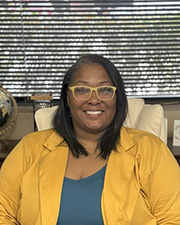
Project title: “Mandated Supporting: Training for Change”
Sharilyn Ray’s capstone project is a training and educational intervention to help mandated reporters of child maltreatment recognize personal biases that impact disproportional reporting and foster placements for impoverished families and children of color. Based on transformative learning theory and principles of cultural inclusion training, the curriculum is an innovative approach focused on implicit bias, critical personal reflection, cultural competency, and new skill development for preparing mandated reporters, instead of a typical legalistic training approach.
Megan Reiss, DSW

Project title: “Practicum Supervisor Preparation and Supervision Needs of Social Work Students in Child Welfare”
Megan Reiss developed a field guide for practicum supervision that is responsive to the needs of three sets of stakeholders: students, supervisors, and the educational institutions placing students in child welfare settings for practicum. The guide is practical and is designed to be implemented and used regularly. It contains topical content, resources, feedback forms, reflective activities, templates for supervision, and many other important components of education. Reiss also provided a thoughtful integration of theoretical frameworks for learning, linking them to social work pedagogy and the immersive experience of practicum. Her next steps are to place the guide in the field, gather information and continue to refine it as needed.
DeMarreo Tidwell, DSW
Project title: “A Community Engagement Toolkit for Overcoming Barriers for Black Families to Access Mental Health Services in Underserved Areas”
DeMarreo Tidwell created a toolkit as a macro-level intervention with the intent of shifting attitudes, enhancing understanding, and building treatment capacity among Black residents in Southwest Little Rock, Arkansas. Guided by a Critical Race Theory in Education framework, the project confronts systemic inequities that hinder Black families from receiving adequate mental healthcare with a tangible, accessible toolkit offering practical strategies for overcoming barriers and access to care.