Alumni Spotlight: Kansas Supreme Court Chief Justice Eric Rosen
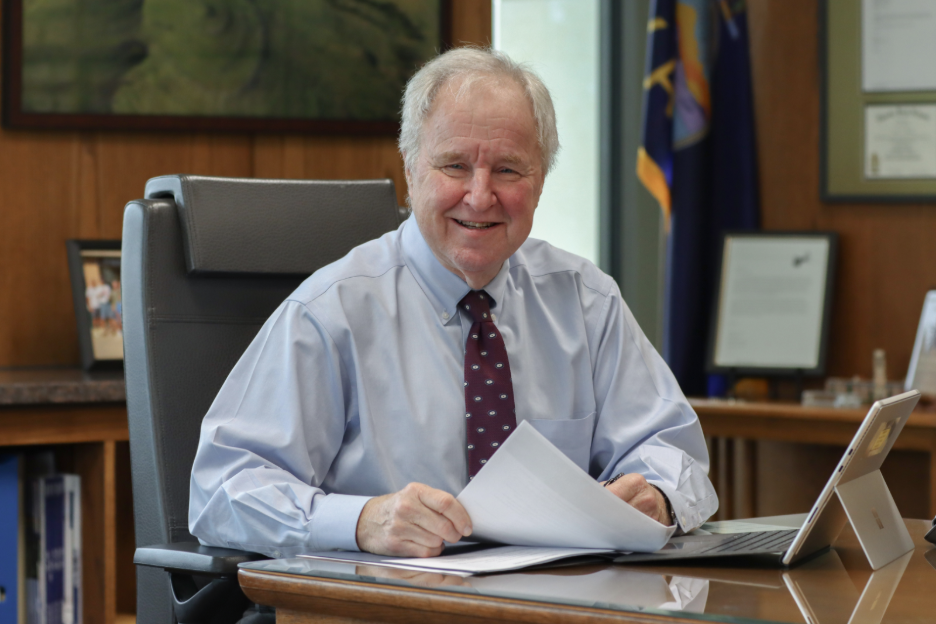
Eric Rosen’s memory is precise. He can weave together his own history and his career in social work, public service, and the Kansas judicial system. More noticeably, he often talks about serving others, and his motivations are consistent.
Rosen remembers the specific year of major life events – including graduating with a Master of Social Work degree from the University of Kansas School of Social Welfare in 1976. A more recent memory was when Rosen became the Kansas Supreme Court’s Chief Justice in January.
His social work education and longstanding interest in mental health have shaped his approach throughout his career. He brought those themes together in his commencement speech at the School of Social Welfare’s 2007 graduation.
“It’s funny because, at the time, I remember thinking the speech wasn’t particularly good,” said Rosen, who was appointed to the Kansas Supreme Court in 2005 by Governor Kathleen Sebelius. “But when I look back at it now, I’m proud of what I said. The issues I talked about then are still with us now. In many ways, I could give essentially the same speech today.”
Rosen’s speech from over 19 years ago highlighted issues facing healthcare and the agencies that are structured to address them.
“Mental illness in many cases is now a crime, not a condition. Our jails and prisons now serve as our state hospitals,” Rosen said in his speech.
Rosen champions his social work background, the important lessons he learned at the University of Kansas, and the opportunities that came from being in the program. Rosen gained valuable experience in his two practicum placements and implemented direct services in Topeka’s public schools before pivoting to a law career.
“I draw on those roots every day. Social work teaches you to collaborate, to confront difficult problems without losing perspective, and to understand people in the context of their lives and circumstances,” Rosen said.
“Those lessons have stayed with me throughout my legal and judicial career. Courts, after all, are institutions that serve the people. Doing that well requires empathy, accountability, collaboration, and perspective; principles I first began learning at KU more than 50 years ago.”

Valued experiences
Rosen started at KU in the fall of 1971, shortly after finishing public school in Topeka. Like many KU Social Welfare alumni, the plan wasn’t always social work. He thought about political science, psychology, education and even meteorology.
Studying social work allowed Rosen to pursue a career that filled his interests but also was flexible to his personal life. Rosen got married while in college, and the social work program facilitated school and work into the equation.
“Because I was raised in a family immersed in mental health, I had an understanding of what social work was and what it could accomplish,” Rosen said. “I chose that path because it brought together so many things that interested me – people, mental health, public service, and the opportunity to make a difference. I didn’t know then where that decision would ultimately lead me, but it has guided me throughout my professional life.”
His family’s history was at the center of this decision. Rosen’s family moved to Topeka in 1952 so his father could study at the Menninger Foundation for his postdoctoral training.
“At the time, the Menninger Clinic was one of the world’s leading centers for psychiatry and mental health, drawing professionals from around the globe to Topeka and pioneering new ways of understanding and treating mental illness,” Rosen said.
“What I was learning at KU fit naturally with the environment in which I had grown up. Topeka was home to this remarkable multicultural community of mental health professionals who were rethinking how we understand and treat people. I didn’t realize at the time how unusual it was to grow up surrounded by that kind of thinking, but it had a profound influence on me,” he said.
“Unfortunately, in many respects, we have taken steps backward in how we respond to mental illness. Too often, problems that should be addressed through treatment and services end up in the criminal justice system. That is something I have cared about throughout my career, and it remains one of the challenges I hope we can continue to address,” Rosen said.
Treatment Advocacy Center reports that nearly 77,000 Kansans live with severe mental illness – less than half receive treatment in a given year. Incarceration rates in Kansas are at 648 people per 100,000, which is higher than the United States’ average and well above other countries, per Prison Policy Initiative.
Rosen earned his first professional job through his social work practicum at Topeka Public Schools. Through that experience, he got to take part in the budding field of school social work. School social work was in its infancy, and Rosen was challenged during his three years providing services such as individual and group therapy for children who needed a place to talk.
There were 14 social workers for the entire district, Rosen said, and he was the youngest person on staff when the director asked him to head up the department. That sort of event became a theme for Rosen.
He valued this experience, but there was a pull for Rosen to explore other career options, which eventually led him to pursue a law degree at Washburn University. Rosen has since had a prestigious law career that included roles as an assistant district attorney, an associate general counsel for the Kansas Securities Commissioner, private practice, and a district court judge for the 3rd Judicial District for over 12 years before he was named to the Kansas Supreme Court.
Becoming Chief Justice wasn’t the plan, but Rosen was the senior-most justice on the court when Marla Luckert went on medical leave last October.
“Becoming Chief Justice was never something I aspired to or planned for, and the transition was both sudden and significant,” Rosen said. “I’d be less than candid if I said it wasn’t daunting. But one thing I’ve learned throughout my career is the importance of surrounding yourself with talented people, trusting them, listening to them, and recognizing that leadership is never a solitary undertaking. I’m fortunate to have an extraordinary team around me.”
Leading aspiration
One of the first things Rosen had to do as Chief Justice was to deliver the state of the judiciary to the Kansas state senate, house, and state officer holders at the dais of the house chamber of the Capitol. This is what Rosen meant when he said “daunting” as he accustomed himself to the responsibilities.
But another responsibility Rosen places on himself is continuing the work on mental health. He sees encouraging progress in the Kansas judicial system through specialty courts focused on mental and behavioral health, substance abuse, and veterans. These courts offer an opportunity to address the underlying issues that often bring people into the justice system, connecting them with treatment and support that can improve their lives, reduce the likelihood they will return to court, and ultimately strengthen their communities.
“These courts are designed to recognize and respond to the particular needs facing people with PTSD, mental illness, substance-use disorders, and other behavioral health issues. The challenge is how our courts can respond in a way that holds people accountable while also addressing the underlying problems that led to their involvement with the justice system,” Rosen said. “We are making great progress, but we still have a long way to go.”
Relevant to this motivation, 13 WIBW reported in May that the Shawnee County Department of Corrections plans to open a new facility designed to address mental health issues with inmates. The department has seen up to 51% of its population facing serious mental challenges, according to the report.
The KU School of Social Welfare is also contributing to addressing mental and behavioral health support in Kansas through the Integrated Health Scholars Program.
Kansas ranks 37th among all states in mental health workforce availability, with one mental health provider for every 450 people, according to a 2024 report from Mental Health America. The program aims to increase the supply of social work professionals prepared to provide high-quality integrated health services in rural areas in Kansas.
Through the different avenues, Rosen represents a greater goal of improving mental health services and treatment in Kansas.
“I hope my leadership can bring both an understanding of what is needed and a commitment to making it happen,” Rosen said. “My social work background and legal training have taught me that systems can change and that institutions can evolve to serve people better. I want to bring that perspective, and that sense of purpose, to our communities across Kansas.”

Advice from Chief Justice Rosen: “Follow your passion but also take the time to understand what that passion really is. If you are here at KU, it means you have already demonstrated the intellectual ability to pursue any number of paths. The more important question is what genuinely excites you, what fits your abilities, and where you believe you can make a difference. If that leads you to social work or public service, pursue it with commitment. There are more ways to make a difference than you can possibly imagine when you are starting out.”
“Whether you go into social work, behavioral health, criminal justice, law, or another profession that serves people, understand your own motivations. Ask yourself where they come from and what experiences you bring with you. Self-awareness is essential when you work with people. You have to understand yourself well enough to distinguish your own experiences and assumptions from the needs and circumstances of the person you are there to serve.”